Custom Tortoise Enclosures & Burrows
Everything a real outdoor tortoise habitat needs — the burrow, the walls, the shade, and Arizona’s AZGFD adoption requirements — plus secure box turtle and sulcata pens in Maryland, Pennsylvania and North Carolina. From the licensed crew that builds them.
Desert Tortoise Enclosure Requirements in Arizona
Here's the part that surprises most Arizona adopters: the habitat comes first. The Arizona Game & Fish Department's Tortoise Adoption Program expects a completed, secure enclosure with a proper shelter before your application moves — the tortoise is placed into a finished home, not a construction site.
- A securely enclosed outdoor space the tortoise cannot climb out of or dig under — a dedicated zone, not the run of the yard
- An insulated burrow or shelter that holds livable temperatures through Sonoran summers and stays above freezing in winter
- No pool or pond access — a hard rule on the program checklists — and real separation from dogs, solved by the layout rather than supervision
- Shade, shelter and forage arranged so the tortoise can thermoregulate on its own, every hour of the day
- Habitat photos submitted with your application — AZGFD reviews the finished enclosure and burrow before placement
| Spec | Published number | Who publishes it |
|---|---|---|
| Enclosure size | 120 sq ft minimum for an adult; ~600 sq ft recommended | Desert Museum TAP checklist (minimum); Tortoise Group (recommendation) |
| Walls | Minimum 18" high, buried at least 8", with an inward overhang of about 3" if wire is used | Desert Museum TAP checklist |
| Burrow cover | At least 8" of soil over the top and sides | Desert Museum TAP checklist |
| Burrow entrance | Facing south, southeast or southwest | Tortoise Group |
| Timing | Enclosure and burrow complete before you apply — habitat photos go in with the application | AZGFD Tortoise Adoption Program |
The programs publish slightly different numbers — the Desert Museum runs the Tucson-area program, Tortoise Group is Nevada’s. We build to clear the strictest spec that applies to your program, so the habitat photos are approval-ready.
The authoritative checklists live with Arizona Game & Fish and the Tortoise Group and the Arizona-Sonora Desert Museum, and they're excellent on animal welfare — what they don't cover is construction: how to actually build the thing so it passes, lasts, and looks like part of your yard. That's the rest of this guide.
Adopting through AZGFD? We build the habitat to the current spec, so your application is ready on day one.
Get a free habitat designHow to Build the Tortoise Burrow
The burrow is the habitat. Get it right and the tortoise thermoregulates itself through 115°F summers and winter brumation; get it wrong and nothing else about the enclosure matters.
Depth & length
Build long and deep enough that the back of the burrow is fully shaded and thermally stable — several shell-lengths of tunnel, sized so the tortoise can turn around at the chamber. Shallow "doghouse" shelters bake in July; depth is the insulation.
Insulated cover
Earth over a structural top — buried block, culvert or framed cover under a deep soil cap sized to current AZGFD and Tortoise Group specs — smooths day-night temperature swings. The surface above should read as landscaping: a mound, a planted berm, not a bunker.
Drainage, always
The single most common DIY failure: a burrow that floods in monsoon season. The tunnel must slope up into the mound or carry a graded entrance swale so water sheets away. A wet burrow in a cold snap is lethal.
Entrance & orientation
Size the mouth close to the tortoise's width — snug feels safe and keeps predators and summer air out — and orient it away from the worst afternoon sun exposure, with the current AZGFD/Tortoise Group guidance as the reference on siting.
This is the part clients most often hand us: we excavate, build and landscape the burrow so it works and disappears into the yard.
Have us build the burrowWalls Tortoises Cannot Climb or Dig Under
Tortoises are shockingly good escape artists — patient, strong, and permanently motivated. Three rules do most of the work:
Make walls visually solid. A tortoise that can see through a fence will pace, dig and climb at that exact spot for years. Solid block, wood or metal barriers calm the behavior; see-through fencing manufactures it.
Respect the climb. Roughly knee-height contains a desert tortoise if the face is smooth and the corners are clean — no rock piles, planters or hardware against the wall to use as a ladder. Large sulcatas need taller, reinforced walls with real footings; they move like slow bulldozers.
Close the underground route. A buried footing or mesh skirt below grade turns digging into a dead end, and gates get sills — the gap under a gate is the most common escape in retrofit yards we're called to fix.
Shade, Plants and Heat
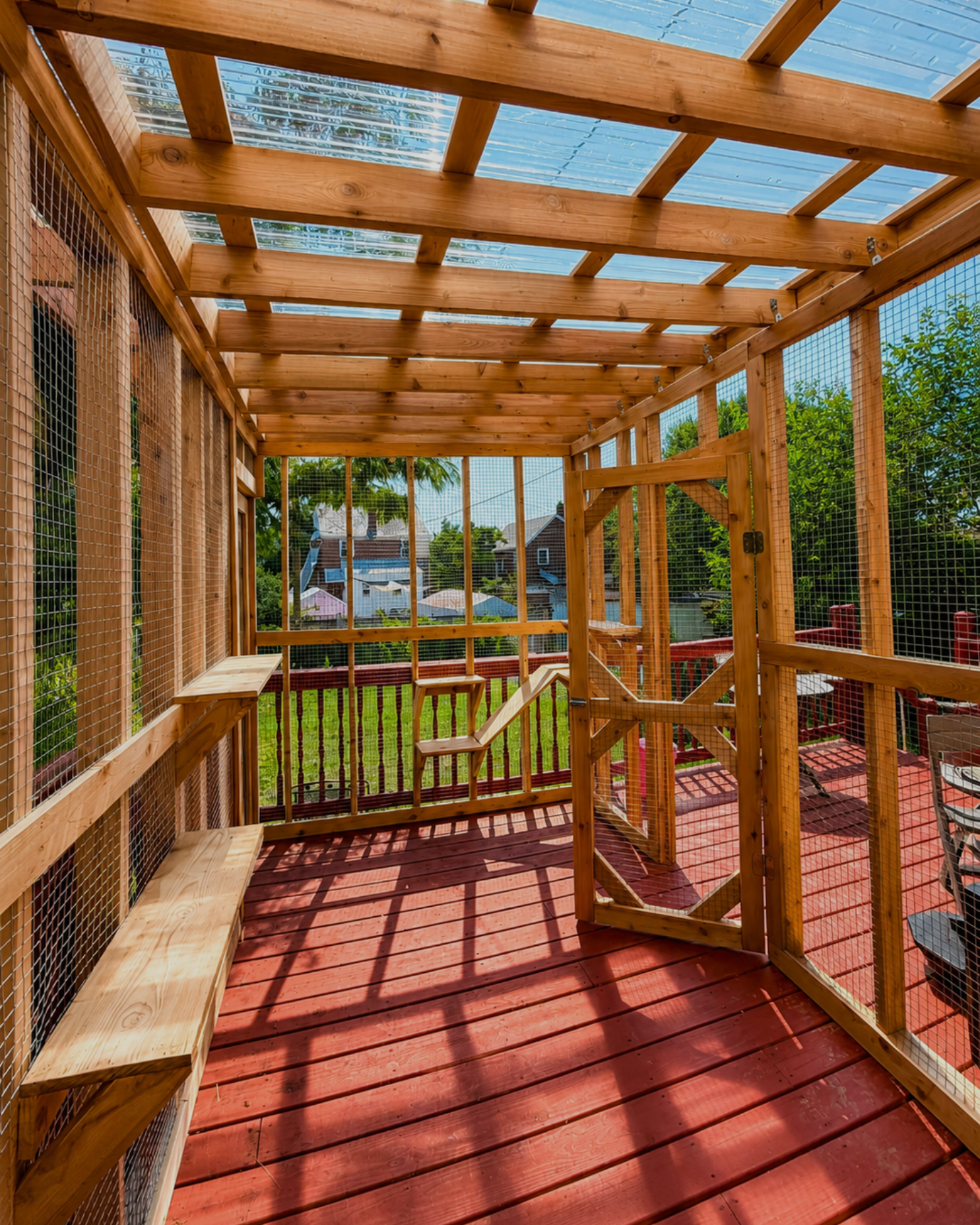
A tortoise manages its own body temperature by moving — so the enclosure's job is to offer real choices at every hour: morning basking spots, deep afternoon shade beyond just the burrow, and cover plants that double as forage. In Arizona that means engineered shade on the west side and heat-aware surfaces (bare gravel at 110°F is a griddle); native forage like grasses and globemallow beats ornamental plants a tortoise shouldn't eat.
Water is a shallow, sunk dish the tortoise can walk into and out of — never anything deep, because tortoises sink. And the whole habitat should read as landscaping: the best tortoise enclosures we build look like a beautiful corner of the yard that happens to have a resident.
The Five DIY Mistakes We Get Called to Fix
- The flooding burrow — dug flat or downhill, fine for ten months, lethal in the first monsoon or cold soak
- See-through fencing — wire panels that turn one wall into a permanent pacing, digging and climbing project
- The corner ladder — rocks, planters or hose reels stacked where two walls meet, giving a climber exactly the boost it needed
- The gate gap — a perfect wall with two inches of daylight under the gate; the fix we're called for most
- The shadeless afternoon — a burrow as the only refuge, forcing the tortoise underground all day instead of letting it choose
We Build AZGFD-Ready Habitats
The walls are what make an outdoor tortoise enclosure an enclosure. From Phoenix to Tucson and beyond, everything in this guide is what we do for a living as a licensed tortoise habitat builder: excavated and insulated burrows, solid walls with real footings, shade structures, and landscaping integration — built to the spec, so your habitat photos are approval-ready and the tortoise gets it right on day one.
Burrow & walls packages
The core habitat: insulated burrow, contained zone, dig-proof footings and a gate with a sill. Quoted from your yard and your tortoise — typically the most affordable custom build we offer.
Shade & landscape integration
Ramadas and shade panels, planted berms, forage beds and hardscape that make the enclosure look like it was always part of the yard — often bundled with wall rebuilds and yard projects.
Licensed, one contract
AZ ROC #364641 — a licensed Arizona contractor building to the adoption-program standard, with design, excavation, construction and cleanup under one contract and one fixed written price.
Outdoor Tortoise and Box Turtle Pens in Maryland, Pennsylvania and North Carolina
Tortoise keeping isn't an Arizona-only thing. From Baltimore and the rest of Maryland through Pennsylvania — Philadelphia to Pittsburgh — and North Carolina, from Charlotte and Raleigh to Asheville, box turtles, Russian tortoises and even well-kept sulcatas live outdoors all summer — and they deserve better than a kiddie pool and hope.
As the tortoise enclosure builder for East Coast keepers, we build the secure outdoor tortoise pen or box turtle enclosure your animal actually needs: solid visual-barrier walls with dig-proof footings, covered sections against raccoons and foxes (a bigger threat to small turtles than anything in the desert), sun and shade zoning for humid summers, and overwintering design appropriate to the species — insulated shelters, and safe brumation setups where that's what the animal needs. For a sulcata tortoise enclosure east of the desert, winter is the whole design problem: we build insulated, heated night boxes and sheds (electrical by licensed trades), sized for an animal that will pass 70 pounds. And an outdoor box turtle pen gets the same treatment at a smaller scale — shade, moisture zones and a secure overwintering corner. Licensed and insured in Maryland (MHIC #167535-02) and Pennsylvania (HIC #PA214722).
Keeping a tortoise or box turtle east of the Mississippi?
Get a free pen designWhat Monument Clients Say
Real five-star reviews from our Google Business Profile — from catio clients and the covered dog pen we built to keep little Yorkies safe in coyote country. Same crews, same predator-proof standard, brought to your build.
"We've actually had a coyote jump over our block wall into the backyard, and we've even had an owl sitting on our patio cover — so we knew we needed something more secure than a typical dog run. They designed a safe, secure, covered dog pen… built on-site by skilled carpenters using high-quality materials. It gives us peace of mind knowing our little Yorkies are protected."
Ruth M. — Google review
"If you want a catio built, hire this company. They did a fantastic job. The entire crew was professional, organized, and kept the workspace super clean. Their communication was next-level… The final result is amazing and my cat is already obsessed with it. Five stars!"
Jeff M. — Google review
"Monument Catios will get you right the first time, my fur babies have never been happier and it's SO nice only connecting with a single contact for a project."
Olivia C. — Google review
"We asked them to design a custom cat shelf system that would allow our cats to make their way around the living room without ever having to touch the floor, and they really took the time to get it right… Our cats absolutely love it. I would absolutely recommend Monument Catios."
Brian M. — Google review
"We hired Monument Catios to give our two kitties a forever playground from kitchen through dining and living room walls. We've had tons of compliments already… Thomas and Luz were wonderful, accessible, and very open to changes. Our kitties couldn't be happier!"
Elizabeth D. — Google review
"I have a smaller space in Scottsdale and honestly wasn't sure a cat wall would even be possible. Monument Catios proved me completely wrong… My cats are obsessed! If you're on the fence because of limited square footage, don't be — these guys will figure it out."
Elizabeth L. — Google review
"I had seen a bunch of cat walls on TikTok and wanted to add one for my cat Stormi, but just had no idea how and couldn't find anyone to help. I then found the team at Monument Catios and it's been such an amazing experience planning and designing a set up for my chonk!"
Jenny A. — Google review
"I got in touch with Monument Catios to design an enclosure for my parents' two cats at their house, and it's been a great experience. The team have been super responsive, transparent, and are clearly cat lovers."
Marc G. — Google review
"The team is extremely kind, caring and responsive. I've had a great experience speaking with them, I would highly recommend to my other friends."
Abigail M. — Google review
Verbatim excerpts from public reviews on our Google Business Profile.
Tortoise Habitat Questions, Answered
What does AZGFD require before you can adopt a desert tortoise?
Arizona Game and Fish requires the habitat to exist before the tortoise does: you must complete the burrow and backyard enclosure before submitting your application, and habitat photos go in with it. The program checklists also bar pool and pond access, and a yard shared with dogs needs real separation built into the layout. Your enclosure is effectively part of the application. We build to the current AZGFD and Tortoise Group habitat guidance so the habitat is ready for your application photos and adoption day.
How deep should a desert tortoise burrow be?
Deep enough that the back of the burrow holds shade and stable temperatures through summer heat and stays above freezing in winter — in practice, a burrow several times the tortoise's shell length, built with insulated cover, sloped so water can never pool inside, and an entrance sized close to the tortoise's width. We build burrows to the current specs published by AZGFD and Tortoise Group, and design them to look like landscape features rather than construction.
How big does a tortoise enclosure need to be?
The published numbers: the Arizona-Sonora Desert Museum’s adoption-program checklist calls for at least 120 square feet for an adult desert tortoise, and Tortoise Group recommends closer to 600 square feet. Bigger is better — more room means more natural foraging and thermoregulation. We design the enclosure around your yard and quote from the design, so the size question becomes a layout conversation rather than a limit.
Who builds desert tortoise enclosures in Arizona?
Monument Catios designs and builds desert tortoise enclosures, burrows and complete habitats across Arizona — Phoenix, Scottsdale, Tucson and beyond — as a licensed contractor (AZ ROC #364641) and dedicated tortoise enclosure builder. We build to AZGFD adoption-program standards under one contract: walls, insulated burrow, shade and landscaping integration, ready for your adoption application.
What kind of walls keep a tortoise in the enclosure?
Solid walls the tortoise cannot see through — visual barriers matter, because a tortoise that can see through a fence will pace and climb at that spot forever. Walls need enough height that a determined climber can't top out (roughly knee-height for desert tortoises, taller for large sulcatas), a footing or buried barrier so digging leads nowhere, and no climbable corner junk like rock piles against the wall. Gates need sills, since a gap under a gate is an exit.
Can a tortoise share a yard with dogs?
Not an unsupervised yard — dog bites are one of the most common serious injuries adoption programs see, and even friendly dogs treat tortoises like chew toys. The standard answer is a dedicated, fenced tortoise zone within the yard, which is exactly what a proper enclosure provides. We design tortoise enclosures for dog households routinely; pools need the same separation, since tortoises sink.
Do you build outdoor tortoise and box turtle pens outside Arizona?
Yes. In Maryland, Pennsylvania and North Carolina we build secure outdoor pens for pet tortoises and box turtles: predator-proof walls and covered sections, sun and shade zones, and overwintering design appropriate to the species — including insulated shelters and safe brumation setups where the species calls for it. Licensed and insured: MD MHIC #167535-02, PA HIC #PA214722. North Carolina projects are performed under the state licensing threshold.
What is different about a sulcata tortoise enclosure?
Scale and force. Sulcatas grow to 70+ pounds, dig industrial-grade burrows, and walk through walls that would stop a desert tortoise. Their enclosures need taller, reinforced solid walls with serious footings, heavy-duty gates, and a plan for the burrowing — either a built shelter that satisfies the digging instinct or reinforcement around the areas they excavate. We size the structure to the adult animal, not the cute one you have today.
Let's Build the Habitat Right
Adopting through AZGFD, upgrading a DIY setup, or building a box turtle pen back east — tell us about the tortoise and the yard, and you'll get a custom design and a fixed written price.
- Built to current AZGFD & Tortoise Group guidance
- Burrow, walls, shade and landscaping — one crew
- Fixed written price and timeline
- Licensed & insured, one contract
AZ ROC #364641 · MD MHIC #167535-02 · PA HIC #PA214722